Thank you, Annie Duke, for today’s inspiration. This passage from Thinking in Bets resurfaced in Readwise, and I’m reminded of how much I admired it when I first read it years ago.
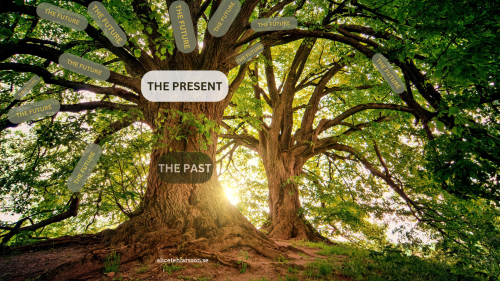
[…] think about time as a tree. The tree has a trunk, branches at the top, and the place where the trunk meets the branches. The trunk is the past. A tree has only one, growing trunk, just as we have only one, accumulating past. The branches are the potential futures. Thicker branches are the equivalent of more probable futures, thinner branches are less probable ones. The place where the top of the trunk meets the branches is the present. There are many futures, many branches of the tree, but only one past, one trunk.”
I created an illustration in Canva to picture myself (as a tree): the past, here now in the present, and so many possibilities in my future.
As the future becomes the past, what happens to all those branches?
Does the present-me cut off all those other branches that didn’t materialise?
If I cut them off, this is not very useful, especially for improving decision quality. I want to increase the chances of good outcomes, and present-me needs help from past-me and future-me.
Keeping those branches of potential futures is great for scenario planning. If I’m going to bet on my future, I want to see all those branches and keep them even after one reality happens.
I want to reduce hindsight bias and unproductive regret. If I “removed all those other branches with a chainsaw and ran them through a wood-chipper”, so to speak, all those possibilities would disappear as if they never existed (even though I’ve thought about them and weighed them).


I’d love to hear your thoughts. Do share! 🖤