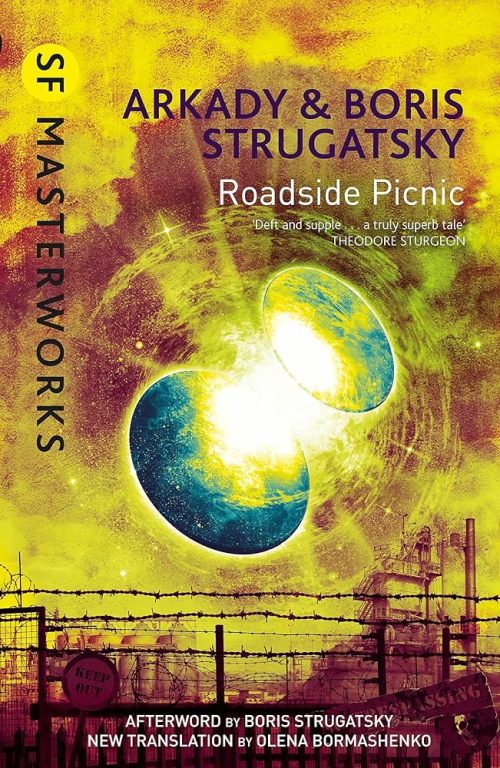
This is the second of four parts of my notes after I finished reading Roadside Picnic. In this second part (see part one), I classify my notes as “Classification”: Sci-fi without scientific answers. For much of Roadside Picnic, I wondered what kind of science fiction I was reading.
There are no conversations with aliens. There are no journeys through space. The visitors have already come and gone before the story begins, and no one knows why.
What remains are the Zones: dangerous areas where ordinary rules no longer seem reliable. Inside them are strange objects with names such as empties, black sprays (“thrash” left behind by the Visitors) and perpetual batteries. Scientists study them, governments control them, and stalkers risk their lives smuggling them out.
These are science-fictional ideas, but the novel offers very few explanations.
Maybe it’s just me. Normally, I expect sci-fi to help me understand its imagined world. Roadside Picnic does something more unsettling: it shows human beings confronting knowledge that may be permanently beyond them. The scientists can observe the alien objects and sometimes make use of them; however, they can’t understand the objects’ original purpose.
I think this changes the central question, where the novel is not asking, “How does this alien technology work?” Rather, it’s asking, “What happens to humanity when we encounter something we are not intelligent enough to understand?”
The answer is not especially flattering.
We study it. We regulate it. We smuggle it. We kill for it. We build careers and black markets around it. And when understanding fails, we fill the gap with theories, superstition and hope.
The science-fiction premise creates the Zone. But the real experiment is what the Zone reveals about us.
Next in the series: Meaning – What does the title of the novel, Roadside Picnic, really mean? What if… what if the aliens never noticed humanity at all?


I’d love to hear your thoughts. Do share! 🖤