“In the court of the fountain the sun of March shone through young leaves of ash and elm, and water leapt and fell through shadow and clear light.” — First sentence
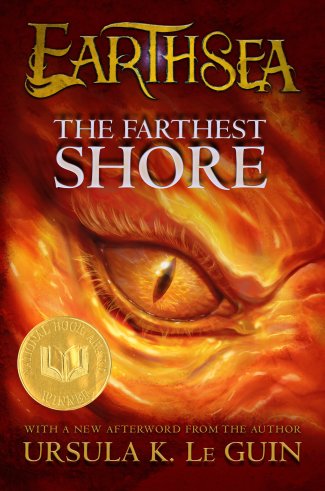
Synopsis from back cover: Darkness threatens to overtake Earthsea. As the world and its wizards are losing their magic, Ged—powerful Archmage, wizard, and dragonlord—embarks on a sailing journey with highborn young prince, Arren. They travel far beyond the realm of death to discover the cause of these evil disturbances and to restore magic to a land desperately thirsty for it.
The third book in the Earthsea Cycle series, The Farthest Shore by Ursula K. Le Guin, is a thought-provoking book that explores death and eternal life. I loved it.
In this one, another wizard with great power—perhaps even one that matches Ged’s—is working a spell. A spell that will throw the world into chaos and upset its balance by denying and avoiding death. To set things right again, Ged and Prince Arren embark on a journey of possibly no return. They travel by sea into the West, the farthest shore. In their adventure, they encounter dragons and the children of the open sea, to name a few. Out in the sea, alone with Arren, Ged talks about choices:
“Try to choose carefully, Arren, when the great choices must be made. When I was young, I had to choose between the life of being and the life of doing. And I leapt at the latter like a trout to a fly. But each deed you do, each act, binds you to itself and its consequences, and makes you act again and yet again. […]” “[…] We must learn to keep the balance. Having intelligence, we must not act in ignorance. Having choice, we must not act without responsibility. Who am I—though I have the power to do it—to punish and reward, playing with man’s destinies?”
At times, Arren grows irritated and distrustful of Ged—even questioning his decision to go with the Archmage. To help you understand why Arren feels that way, Ged doesn’t use his magic freely and even gets hurt, so Arren wonders why Ged refuses to act like the mage he is. Ged seems to philosophise a lot without taking real action. Therefore, he begins to doubt Ged and wonders if they are doing the right thing.
This book shows us that people (cue in the bad wizard) will do terrible things to gain eternal life. “To claim power over what you do not understand is not wise, nor is the end of it likely to be good,” Ged says. In the quest for eternal life, they are willing to give up their true names out of fear of death. In return, they become slaves; darkness takes over. Even though they live, they wish they were dead. Even dragons, the oldest beings, lose their Old Speech and turn on each other.
This story tells us that in death, we know life. I have enjoyed The Farthest Shore, especially the encounters with the dragons. Onward to Tehanu, the fourth book in the series!
Related Posts:
A Wizard of Earthsea (Book 1 of the Earthsea Cycle series)
The Tombs of Atuan (Book 2 of the Earthsea Cycle series)
Tehanu (Book 4 of the Earthsea Cycle series)

