“If wealth and honor do not dissipate you, poverty and low status do not make you move from your principles, authority and might do not distort you, then you can be called a great man.” — Unknown
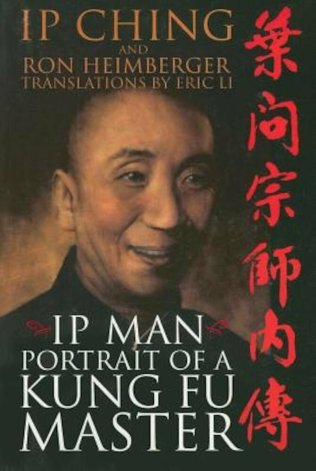
When I first saw the Ip Man movie billboard starring Donnie Yen, I was intrigued by the title, which is the name of the legendary Wing Chun grandmaster. I must admit I was drawn to the fact that Donnie Yen (my favourite martial arts star) plays the grandmaster. I decided I must read the grandmaster’s life story before I watch the movie to appreciate it better.
I did some research and found this book, Ip Man: Portrait of a Kung Fu Master, written by his son, Ip Ching, who is now the grandmaster. The book is co-written with Ip Ching’s disciple, Ron Heimberger. I decided to write this review only after watching the movie. The book offers stories of the great Wing Chun Master’s life. It also provides fifteen principles as a guide to mastery, but none of the actual Wing Chun moves.
From my reading, I can see that Ip Man is indeed an honourable man. He never exploited the art of Wing Chun nor took advantage of his students. He demonstrated the principles of loyalty and love: […] loyalty gives rise to loyalty and love to love. If one desires loyalty, he must be loyal. (p. 83)
Ip Man was first taught by Chan Wa Shun, whom he called his ‘sifu’ (or kung fu master). After Chan Wa Shun’s death, he later perfected Wing Chun through Leung Bik, his ‘si pak’ (or kung fu uncle). Although Leung Bik taught him the most, he never addressed him as sifu. For Ip Man, Chan Wa Shun will always be his sifu. Through this, he demonstrated his unwavering loyalty to his master and earned the respect of the martial arts community. His students gained the spirit of Wing Chun’s selfless service, complete loyalty and unfailing courage.
Another thing that resonated with me in the book is this: True mastery, true competition is a matter of the self. (p. 68) I agree that one faces competition with himself alone and should always try to be better. Being contented is fine, but we must not be lazy or complacent with our current successes.
The short chapter on “What’s In A Name?” sheds light on the romanisation of Chinese writing and how it affected the grandmaster’s name. The correct spelling is Ip Man, not Yip Man, as many people spell it. This is important because changing a proper name is changing the person himself. Hence, the book advises that when dealing with Chinese art, literature, and culture, one cannot and should not assume readily, no matter what.
I thoroughly enjoyed reading about the grandmaster’s life in Foshan and Hong Kong, and viewing the many photos in the book. Perhaps the most striking thing to me was how he learned the art of Wing Chun and ultimately perfected it. As the book says, without Ip Man, Wing Chun would be lost today (p. 91). He has touched many lives, especially the lives of his students. He understood Wing Chun’s tradition and honour. He is also Bruce Lee’s only kung fu teacher.
Note: While the movie Ip Man is about the grandmaster, it is not based on this book. Donnie Yen, whose martial arts background began from the day he could walk, is fabulous for the role. The movie is a must-watch!
“Some are born with the knowledge of their duties; some know them by study; and some acquire the knowledge after a painful feeling of their ignorance.” — Confucius

