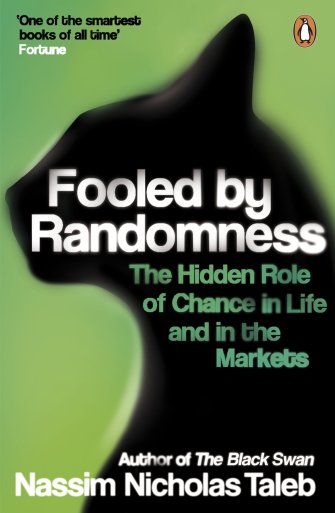
I revisited this book again in August this year for a book discussion with my colleague, Eugene Foong. He was preparing a presentation for his master’s degree based on the same book. One day during lunch, he asked if I had read Nassim Taleb’s Fooled by Randomness, and I answered yes. That’s how the book discussion began.
It is interesting to note Taleb’s observations on how chance plays a part in success. He says luck is democratic and hits everyone, regardless of original skills. Take the example of millionaires:
“That all millionaires were persistent, hardworking people does not make persistent hard workers become millionaires: Plenty of unsuccessful entrepreneurs were persistent, hardworking people.” (p. xiv)
The book is written in a conversational manner, and the author tries his best to make the confusing subject of randomness less confusing. Randomness is broken into three parts: part one covers skewness, asymmetry and induction; part two covers survivorship and biases; and part three covers the human aspects of dealing with uncertainty.
Quoting from Chapter One of the book, from the example of a guy named Nero Tulip, it essentially sums up what the entire 300-plus pages of the book:
“Nero believes that risk-conscious hard work and discipline can lead someone to achieve a comfortable life with a very high probability. Beyond that, it is all randomness: either by taking enormous (and unconscious) risks, or by being extraordinarily lucky. Mild success can be explainable by skills and labor. Wild success is attributable to variance.”
The book is lengthy because Taleb provides many examples and elaborates on the three biases:
- Survivorship bias arises because we see only winners and get a distorted view of the odds.
- The fact that luck is most frequently the reason for extreme success.
- The biological basis of our inability to understand probability.
It’s an interesting read, but not for everybody (not quite for me, either). If you want a thought-provoking read, you can give this book a go; Fortune calls it “One of the smartest books of all time.”

