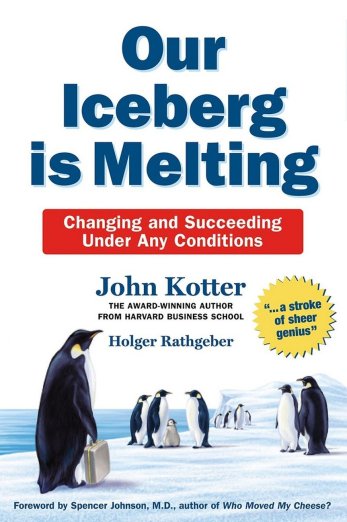
Our Iceberg Is Melting by John Kotter and Holger Rathgeber is not just a story about cute emperor penguins in Antarctica; it’s much more than that. The penguin fable draws on the frameworks in Leading Change (by John Kotter in 1996) and The Heart of Change (also by Dr Kotter, co-written with Dan Cohen in 2002). At first glance, the book may look silly, but it draws on the power of good stories to influence behaviour and compel actions.
Discover how to use the “Eight Steps Process of Successful Change” (as the penguins did even without knowing them) to enjoy even more success in these changing times. This book applies not only to people in the business world but to everyone. We are all affected by changes whether we like it or not. How we respond to those changes determines whether we thrive or suffer.
Here’s a glimpse of the Eight Steps:
:: SET THE STAGE ::
#1: The penguins in the change committee create a sense of urgency in the colony to deal with a difficult problem, i.e. their iceberg is melting, and if they do not find a substitute iceberg to live on, they will all perish in the winter, which is approaching in two months’ time.
#2: The change committee forms a carefully selected group to guide the change. The committee consists of Louis, who is the head penguin with great leadership skills and authority; Buddy the Professor for his excellent communication skills (he’s well-liked by the colony of penguins); Fred for his analytical skills (he’s the one who discovers that the iceberg condition has ‘changed’ over time through his observation and alerts the Leadership Council, aka the Group of Ten; and finally Alice, who has a great sense of urgency (she is an important member of the Council and does not judge anyone by status).
:: DECIDE WHAT TO DO ::
#3: The change committee then develops a clear vision of a better future and crafts a strategy aligned with it. It is important to see how the future will differ from the past and how to make that future a reality.
:: MAKE IT HAPPEN ::
#4: They also communicate for understanding and buy-in. To get the message out, Louis calls a meeting with the entire colony. He gives a speech, along with the PowerPoint presentation prepared by the Professor, which the eloquent Buddy will present. Louis understands how hard it is to talk to birds who are anxious, preoccupied, sceptical, tradition-bound, and unimaginative (this sounds a lot like us humans, no?). To strengthen the message, Alice suggests putting out ice posters with slogans as a constant reminder of what they have heard. They involve the other penguins in coming up with the new slogans and even found innovative locations to put up the posters, such as underwater next to the most popular fishing grounds.
#5: They empower others to act by removing as many obstacles to action as possible. Even the children have a role to play in the mammoth endeavour. Case in point: Sally Ann, a kindergarten student. She approaches Alice and asks how she, too, could become a hero. She has many friends, and her influence has brought forth the idea called “Tribute to Our Heroes Day.” It was truly heartwarming.
#6: The committee knows it needs to create some sort of success quickly (as one MBA-sounding bird puts it, “a short-term win”). Louis calls on Fred to create a team of scouts to search for potential new homes. Meanwhile, a practical solution is being executed for “Tribute to Our Heroes Day,” when fish are gathered to feed the tired and hungry scouts when they return.
#7: Don’t let up until the new way of life is firmly established. It is tempting to declare that the colony has been subjected to enough change and should settle down, but they know it is important not to be complacent. So they keep on looking for better icebergs.
:: MAKE IT STICK ::
#8: Finally, a new culture is created to ensure that tradition does not overcome the changes. The story of “The Great Change” is repeated again and again to younger generations of penguins.
There you have it: the eight-step process. Before I forget, in any change endeavour, people will always oppose it and create resistance. In this story, it is NoNo, the weather forecaster. The characters in the story are people we can recognise and even see in ourselves.
It’s an important and fun book to read (more fun when I’m one of the characters named in the story…). Here’s what the Professor thought of Alice when he is asked by Louis to deduce their strength:
Alice. Practical. Aggressive. Makes things happen. Doesn’t care about status and treats everyone the same. Impossible to intimidate, so don’t even try. Smart (but not an intellectual heavyweight).
I can definitely relate to what the Professor thinks of Alice the Penguin, but no, I don’t think I’m all that aggressive…
This is a great book, and you can definitely finish it in one sitting. It’s very easy to read and has lots of nice colourful illustrations. Bonus: If you love penguins, you’ll love this book.
I would like to thank my colleague, Lucy, for lending me the book. I will get a copy for my personal library because it’s definitely worth keeping one for future rereading.

