“It was a pleasure to burn.” — First sentence
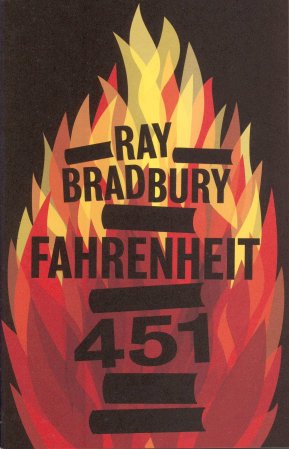
Fahrenheit 451 is a classic written by Ray Bradbury. The novel is originally a short story entitled “The Fireman” published in the Galaxy Science Fiction in 1951 and two years later expanded into Fahrenheit 451. It’s a story about books, and it’s not a happy one, because you see, it’s a crime to possess books, and if anyone is found to keep them in their houses or read them, they will be reported and everything will be burned to ashes—the books, the house, and sometimes even the owners. Why? Because books give readers ideas of unhappiness, pain, suffering—they are evil.
Normally, firemen put out fires, but in Bradbury’s story, they don’t. Instead, the firemen start fires to burn books. As the title Fahrenheit 451 suggests, the number 451 is the identification of a particular fireman in the story, and his name is Guy Montag. Montag takes pride in his job. One fine day, he meets an unusual girl named Clarisse McClellan. She brings about realisations and asks pertinent questions such as “Are you happy?” or “Are you in love?” They most certainly have something to do with books, and then she suddenly disappears. Later, he bumps into a professor named Faber in the park, and one thing leads to another.
The world Montag is in is definitely an odd one. This is one place where the hatred for books is so strong (and it’s normal!). Happiness is the highest goal through the pursuit of trivial information, and knowledge and ideas are bad. After meeting the two key people who are about to change his life, Montag is shaken. He begins to question, to seek. His listless wife, Mildred, spends her day watching television and listening to the radio, doing nothing. In one of his firefighting duties, he did the unthinkable. He steals a book and hides it at home. And he hides more and more of them. He thinks his career as a book-burner is about to end. His fire chief, Captain Beatty, tries to talk him to his senses. His wife eventually turns him in. He runs away, but not before being forced to burn his own books first.
What will happen to Montag?
I love the way Bradbury uses imagery in the story. The mechanical hound, the salamander, the phoenix—they all trigger imagination. It’s compelling storytelling and disturbing, to say the least. I also enjoyed reading Captain Beatty’s clever ramblings as he spouts lines from classics in his one-sided debate with Montag. Although it’s a short book, it took me longer than usual to finish, as it has many thought-provoking parts and I dwelt on them a tad longer.

