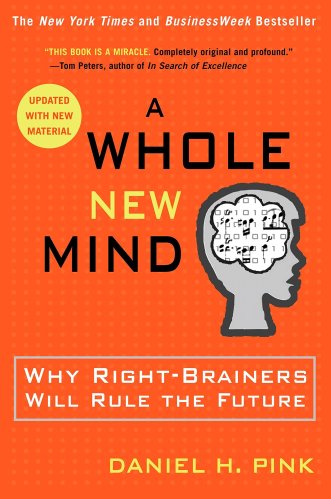
A Whole New Mind by Daniel Pink is an interesting and practical book. The book has two parts: Part 1 covers the conceptual age, and Part 2 explores the six senses needed to develop a whole new mind for this new era.
Pink talks about how our future will depend on our ability to ask and answer the following three questions that will determine who gets ahead and who gets left behind:
- Can someone overseas do it cheaper?
- Can a computer do it faster?
- Am I offering something that satisfies the non-material, transcendent desires of an abundant age?
To cover the above, Pink explains how both sides of our brains (left and right hemispheres) function, leading to “L-Directed Thinking” and “R-Directed Thinking” approaches. We need both approaches to lead fulfilling, productive lives. “L-Directed Thinking”—sequential, literal, functional, textual, and analytic—drives us. However, the once-disdained and dismissed aptitudes of “R-Directed Thinking”—artistry, empathy, taking the long view—now determine who soars and who stumbles.
To elaborate on the importance of “R-Directed Thinking,” he discusses abundance, Asia (think outsourcing), and automation (think how computers do your work better, faster, or cheaper). These have created a need for high concept and high touch. Therefore, we must perform work that overseas knowledge workers can’t do cheaper, that computers can’t do faster, and that satisfies the aesthetic, emotional and spiritual demands.
With that, Pink distilled the six abilities or senses needed to achieve all of that, which are covered in Part 2 of the book. The six senses are:
- Design
- Story
- Symphony
- Empathy
- Play
- Meaning
According to Pink, those who master these abilities will have a huge advantage. I believe him too. One chapter is devoted to each of the six senses, and he describes how to use them in your business and daily life. Please read the book to find out how. A notable feature of the book is the shaded ‘Portfolio’ section, which contains a collection of tools, further readings, and websites to help you better understand each sense.
This book introduced me to many new materials. For example, in the chapter ‘Story,’ I learned about Scott McCloud’s Understanding Comics: The Invisible Art. Many other interesting things await your discovery. I would encourage you not to miss it.

