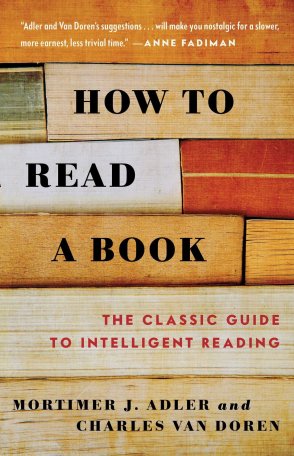
How to Read a Book by Mortimer J. Adler and Charles Van Doren offers insights into the problems of learning to read and provides a comprehensive, better-ordered analysis of the complex art of reading. I also enjoyed applying the basic rules to different types of reading and discovering new rules of reading. Written first by Adler, Van Doren later joined Adler as a co-author in updating, recasting and rewriting the book. It was first published in 1940, became a bestseller and was translated into other languages such as French, Swedish, German, Spanish and Italian.
The book has four parts. Part 1 covers the art of reading and introduces four distinct levels of reading: elementary, inspectional, analytical and syntopical. Parts 2 and 4 further explore analytical and syntopical reading. Part 1 also explains in detail the first level of reading (elementary) and second level of reading (inspectional). It also includes a chapter on how to be a demanding reader. This chapter interests me as it means reading as actively as possible. Good books, whether fiction or non-fiction, deserve that kind of reading. I also learned about the four basic questions any reader should ask when reading a book. One more thing that caught my attention in Part 1 is how to make the books my own. By that, I mean making marks intelligently and fruitfully; methods include underlining, drawing vertical lines in the margin, and writing in the margin or at the top or bottom of the page.
Part 2 deals with analytical reading. This section guides us in analysing and interpreting a book. I’ve learned about pigeonholing a book; X-raying it; coming to terms with an author; determining the author’s message; criticising a book fairly; agreeing and disagreeing with an author; and aids to reading. The activity of reading does not stop with understanding what a book says, but must be completed by the work of criticism, the work of judging. An important remark is made here regarding criticism. A popular misconception is that criticism always means disagreement. Agreeing, disagreeing, and suspending judgement are all acts of criticism. In a nutshell, three stages of analytical reading are formed by outlining, interpreting and criticising a book. At this point, I would like to quote the author:
Many readers, and most particularly those who review current publications, employ other standards for judging, and praising or condemning, the books they read—their novelty, their sensationalism, their seductiveness, their force, and even their power to bemuse or befuddle the mind, but not their truth, their clarity, or their power to enlighten.
Part 3 is interesting because it covers approaches to different kinds of reading matter. This includes how to read practical books, imaginative literature (stories, plays and poems), history (biographies and autobiographies, current events and digests), science and mathematics (classical and popular science), philosophy, and social science. This section takes away my fear of literature. I realise that while non-fiction is vital for the conscious mind, fiction satisfies the many unconscious, as well as conscious, needs. During my English Literature class many moons ago, I was taught to stop and look up difficult words in the dictionary whenever I saw one while reading the assigned literary piece. This is precisely the problem, and the book highlights it as a common mistake people make. After reading this section, I walk away enlightened and determined to explore further.
Part 4 covers syntopical reading, which is the fourth and highest level of reading. It involves reading two or more books on the same subject. This chapter includes the five steps of syntopical reading.
The book includes a recommended reading list at the end, along with tests to measure our progress in reading skills, comprehension and speed. To become well-read, one must know how to use whatever skill one possesses with discrimination. This means reading every book according to its merit (some worth reading well, some only worth inspecting). I will also heed its advice to tackle books beyond me, because I will not improve as a reader if all I read are books well within my capacity. Stretching myself is the key message here.
I highly recommend this book (warning: the author can be a little long-winded at times). Schools should make this part of their syllabus, as it could have prevented many reading-related problems and phobias, especially with materials like classic literature, history, etc.

